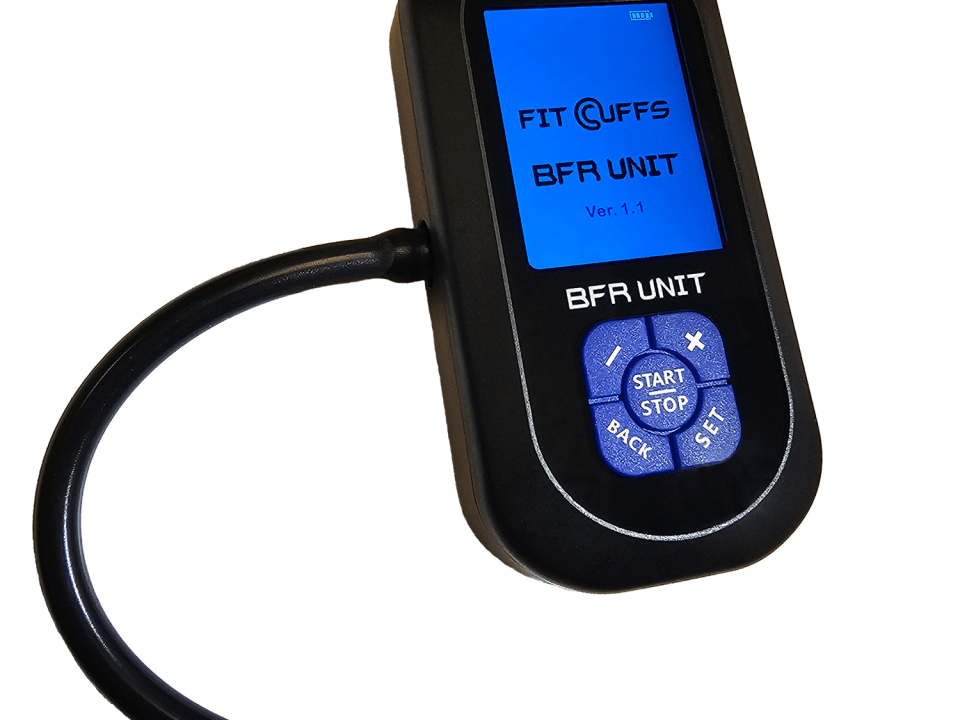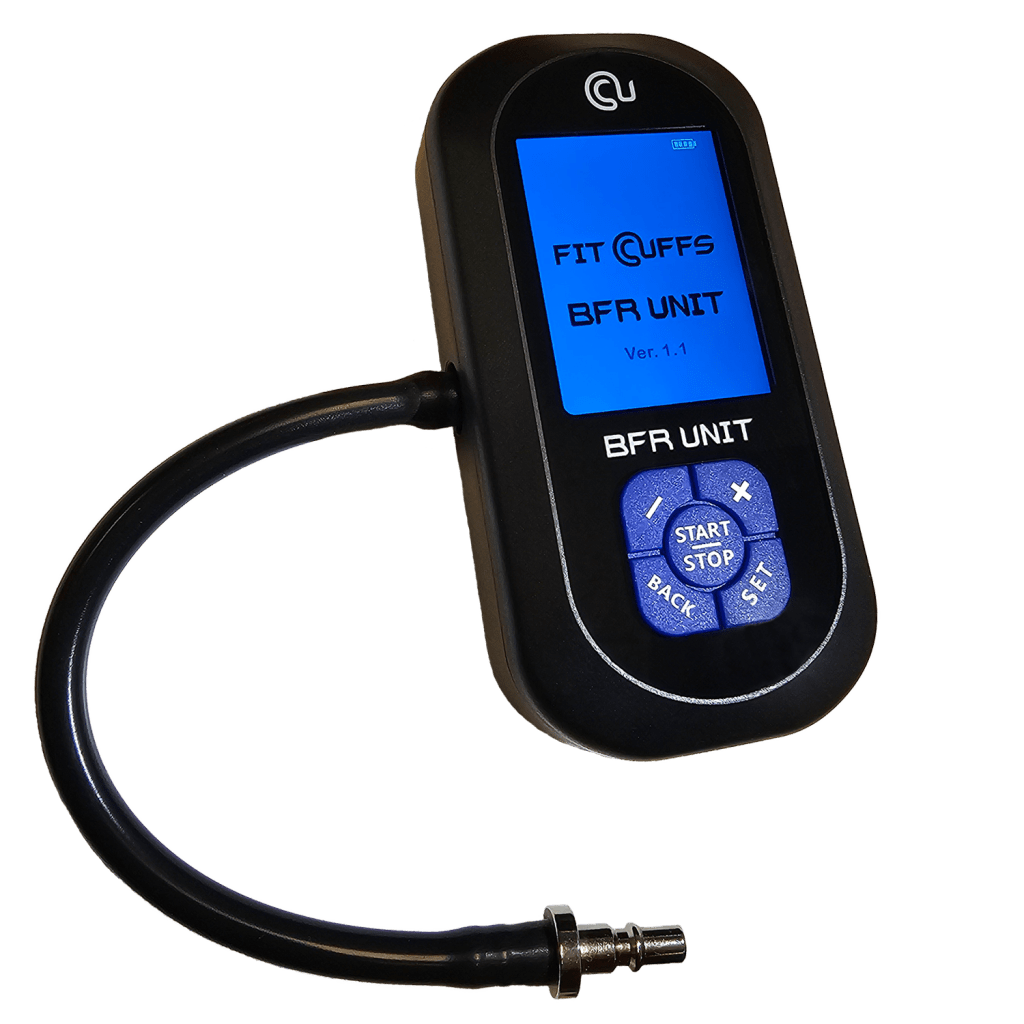


Fit Cuffs BFR Unit V1.1 measures your Limb Occlusion Pressure (LOP/AOP) and Auto-Adjust mode keeps the pressure steady
So, what does Auto-Adjust really do, and does it change your results or experience with BFR?
How Auto-Adjust operates
When you contract a muscle, it expands and the pressure inside the cuff raises. The BFR Unit detects those fluctuations and pumps to correct the drops and pressure spikes.
It’s a small, portable unit, though, so there are limits. The pump can only work so fast, and it can’t react to higher change in the middle of a fast dynamic movement. Think of Auto-Adjust as a way to keep pressure more consistent, not as a promise that your target pressure holds every split second of the set. You can mitigate any delay in the pressure responsiveness by having a more controlled contraction speed I.E 2-3 seconds excentric and concentric muscle contractions. The V1.1 also brings a longer-lasting battery, a bigger and easier-to-read display, and more flexible interval settings
What does the research say?
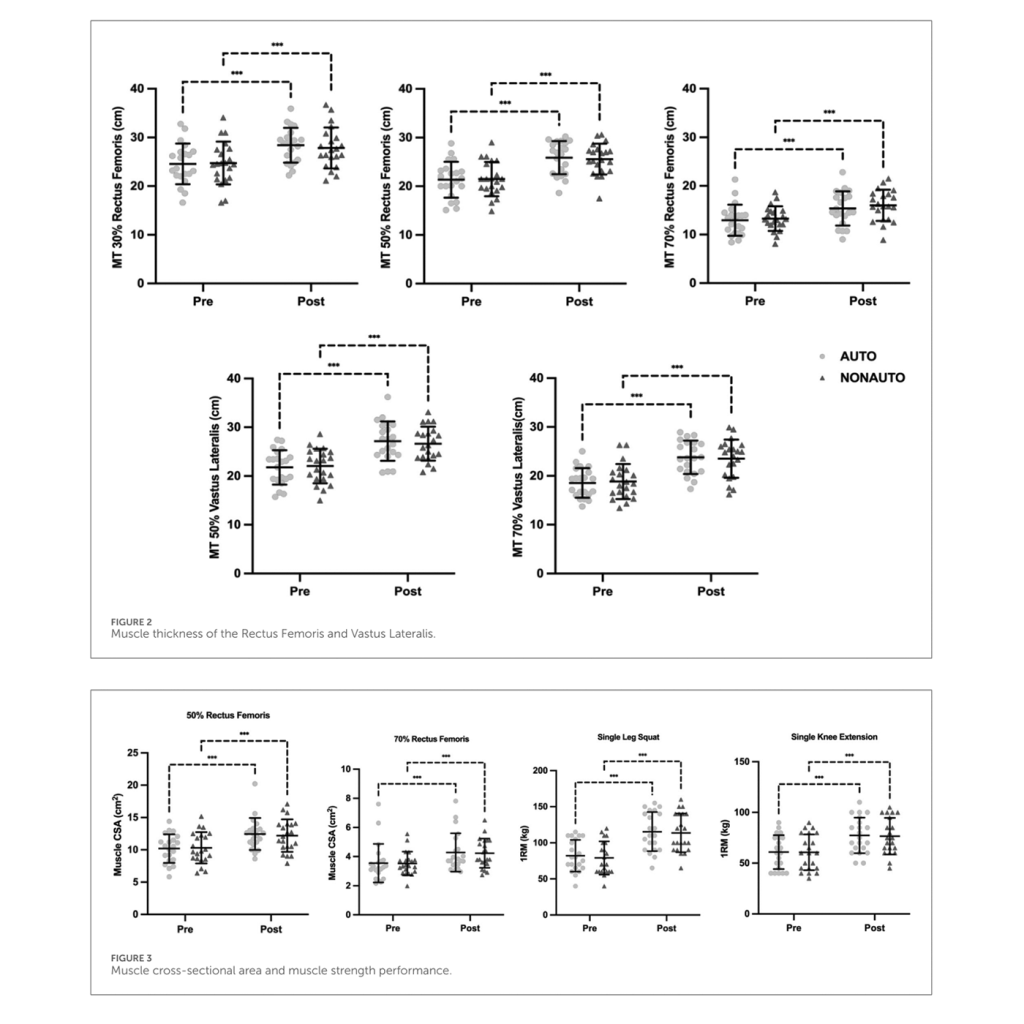
A 2026 study by Akçay & Co.in Frontiers in Physiology put this question to the test. Here’s the setup in short form:
• Study-population: 21 resistance-trained men
• Exercise protocol: Everyone trained both legs with the same exercises for eight weeks, unilaterally. One leg trained with Auto-Adjust (pressure adjusted automatically during exercise). The other leg trained with No-Auto-Adjust (pressure set at the start and not adjusted afterwards).
The result: both legs got bigger and stronger, and the difference between Auto-Reg VS No-Auto-Reg wasn’t statistically significant. The men also rated effort and discomfort about the same.
So, in this study, Auto-Adjust didn’t add anything extra for muscle size or strength. That doesn’t mean it’s pointless everywhere. This was one group of trained men over eight weeks, and rehab settings or other protocols might tell a different story. Some earlier research has also found differences in how the body responds during a single session, so the picture depends on the protocol and on what you measure.
Do you need Auto-Adjust to get good results?
No, not necessarily. What matters most is the basics: the right cuff, a pressure matched to the individual, sensible exercise choices, and a protocol you can stick with. Auto-Adjust is a helpful extra for managing pressure swings, but it isn’t a requirement for gaining size or strength.
It’s also worth remembering that BFR systems aren’t all the same. Response speed, control algorithms, and hardware vary from device to device, so a result from one system doesn’t automatically apply to another.
If you’re a clinician, rehab professional, or coach, pick the device that fits how you’ll actually use it, and follow established BFR guidelines.
Our take
We built the V1.1 to make BFR easier to get into: automatic LOP measurement, adjustable training modes, and a compact design you can take anywhere. Auto-Adjust is one part of that, and we’d rather describe it honestly than oversell it. It’s a useful feature, but it doesn’t replace good pressure selection, solid programming, or professional judgement when you need it.
Bottom line: The V1.1 gives you convenient pressure management. Whether Auto adjustments matters for you depends on your goals and setting, and the current evidence says it shouldn’t be assumed just because a device has an automatic mode.
Read more about the BFR Unit V1.1 here
Source
• Akçay et al. (2026) Autoregulation during blood flow restricted exercise offers no additional benefit on thigh muscle hypertrophy and strength adaptations in trained participants: a randomized within-subject 8-week trial
• Nicholas Rolnick (2024) Unpacking the blood flow restriction device features literature: autoregulation
• Rolnick et al. (2026) Editorial: Impact of blood flow restriction device features and methodological considerations on acute- and longitudinal responses to blood flow restricted exercise
• Joel Novak (2026) Pressure prescription in blood flow restriction training: evaluating the role of arterial occlusion pressure