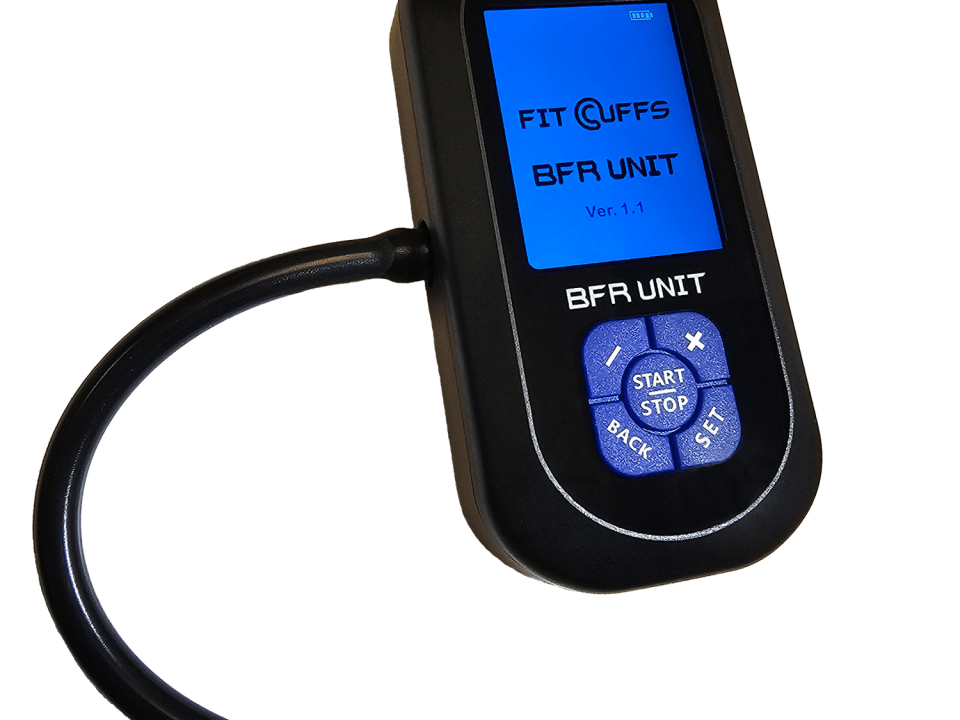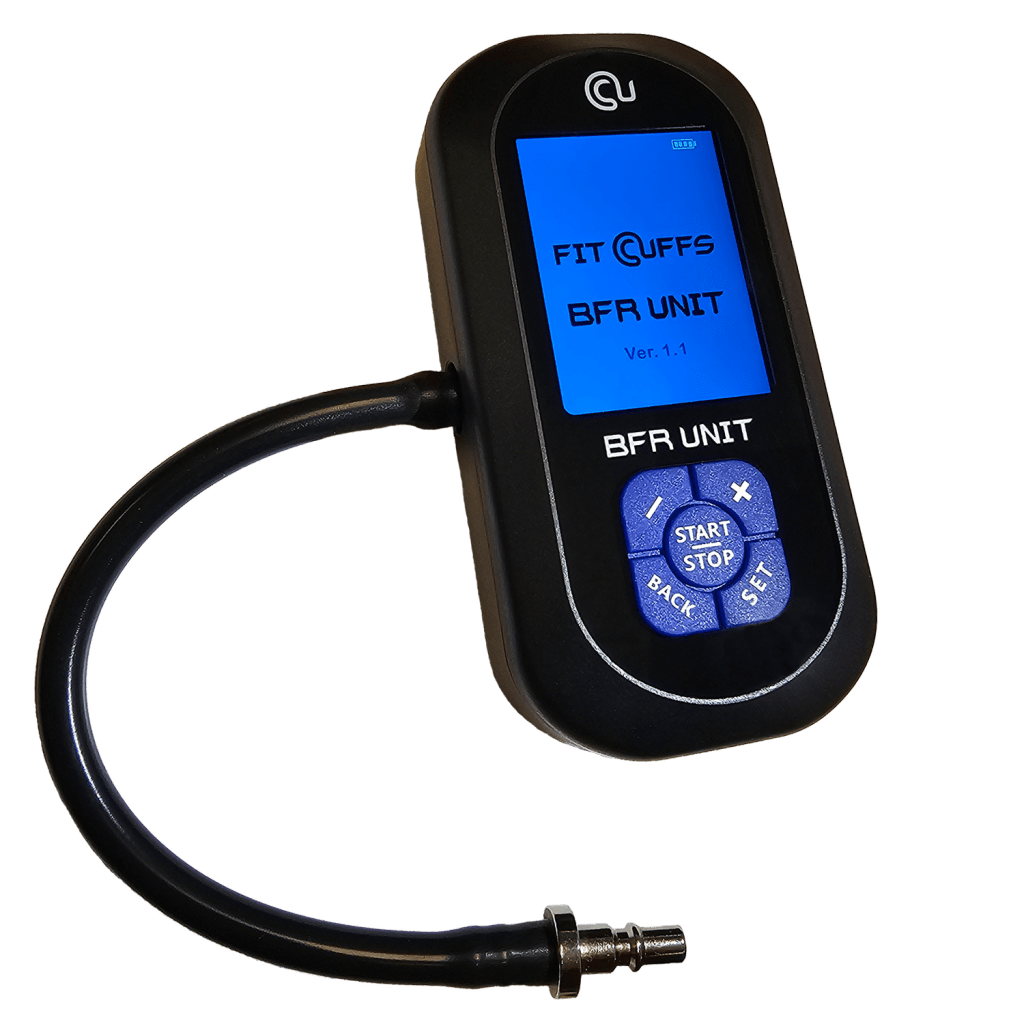

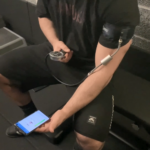

This post is about the brand new Bluetooth Unit for measurement of Limb Occlusion Pressure (LOP) by means of Oscillatory Blood Pressure (BP) (1,2).
When assessing BP you should always use a calibrated cuff in terms of the width of the cuff relative to the circumference of the limb you are assessing. The recommended cuff width is 0.4 relative to the circumference of the limb (3).
That is why a standard BP cuff is about 14 cm wide, which is a calibrated cuff size relative to the upper arm for most adults. But if you are assessing BP on obese or bodybuilders, this would not be a valid measurement of BP, as in these cases you would need a wider cuff to avoid overestimating BP (4). The same principles apply for a very small upper arm, as you need to use a narrow cuff (4).
So even though measurement of BP is only valid when using a calibrated cuff, the amount of pressure to completely stop arterial blood flow is both valid and reliable (5).
Practical Application – how to find LOP via Bluetooth:
Connect the Unit with your phone via standard bluetooth tech.
Connect the Bluetooth Unit with the hose of the Fit Manometer, then connect the unit to the cuff.
Completely rest the corresponding limb and follow the displayed guide provided by the app.
After appropriate measurement you will find SYS (SBP) on the top left corner on the phone. This is the Limb Occlusion Pressure (LOP) for that limb in that particular position, just as the standard but prolonged method with a hand held doppler.
When preparing for exercise just detach the Bluetooth Unit and set the pressure relative to SYS (40-80%).
Research has shown that this method (oscillatory blood pressure measurement), is more precise compared to a hand held doppler ultrasound, relative to the golden standard i.e. invasive methods (5).
Our preliminary testing is showing a very good inter-rater reliability, by comparing this bluetooth device vs. LOP by hand held doppler, as a variance of only 3-6%.
Source:
(1) Babbs (2012) Oscillometric measurement of systolic and diastolic blood pressures validated in a physiologic mathematical model.
(2) Berger et al. (2001) How Does It Work? – Oscillatory blood pressure monitoring devices.
(3) Beevers et al. (2001) ABC of hypertension Blood pressure measurement Part I -Sphygmomanometry: factors common to all techniques. Clinical review.
(4) Croft & Cruickshank (1990) Blood pressure measurement in adults: large cuffs for all?
(5) Jordanow et al. (2018) Comparison of oscillometric, Doppler and invasive blood pressure measurement in anesthetized goat.
(6) Zachary et al. (2020) Limb Occlusion Pressure: A Method to Assess Changes in Systolic Blood Pressure.