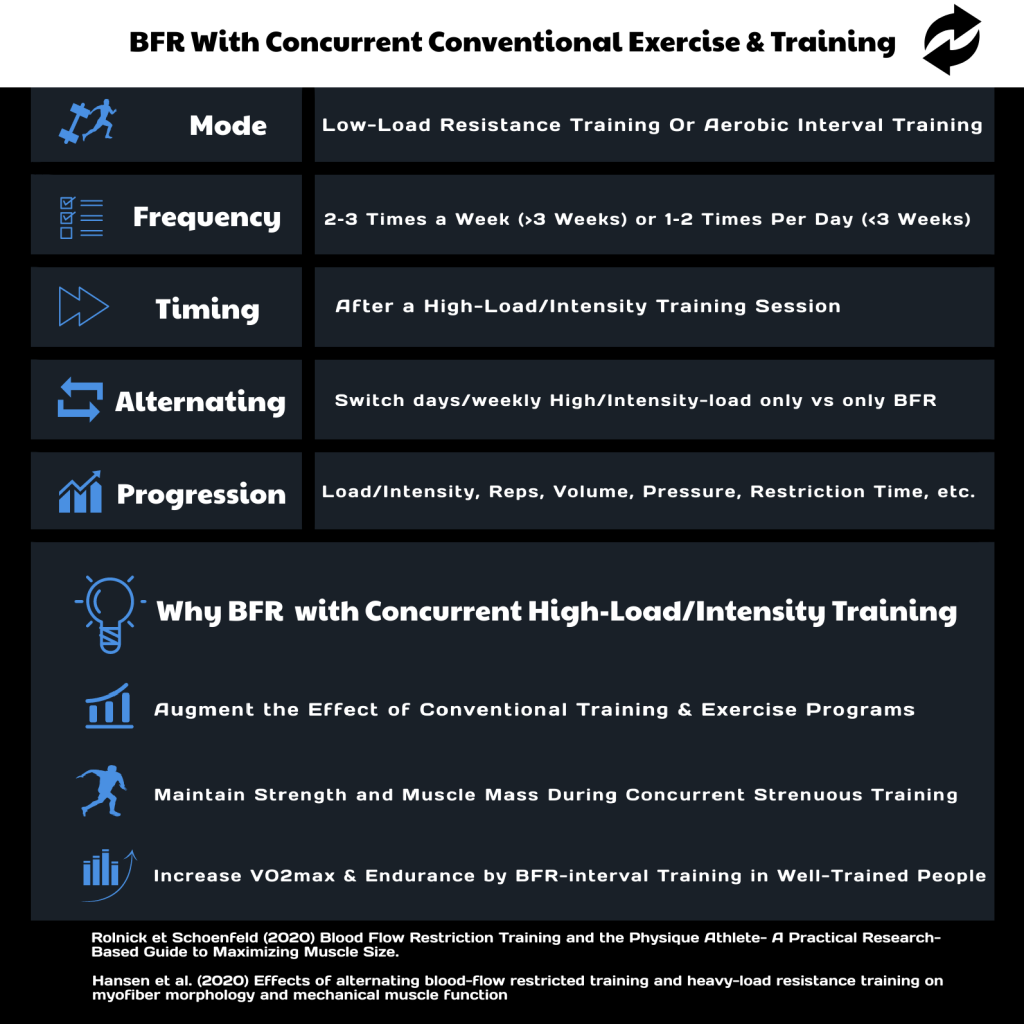



This is a follow-up to the latest post on the framework for a complete practical guide for Blood Flow Restriction (BFR) Training for clinicians, average Joe’s and athletes of all levels.
If you haven’t already spotted the recent post, we advise you to have a quick look. In the present post we describe some additional guidelines for BFR in Rehab, BFR with conventional exercise and BFR in sports performance.
Regarding BFR as a performance modality, it should be acknowledged that the different protocols effects many of the same parameters. It should also be noticed that the science in BFR for performance is a less explored field of research and many different protocols have been proposed. So, as this is still very preliminary and optimized training protocols will undoubtedly be discovered in the nearest future.
It should also be considered, that regular low-load resistance BFR training has proven it worth as a performance enhancer, relative to the athletes baseline form. Another relevant thing to consider, is the expected inter-individual response to different protocols and importantly, personal preferences for different exercise modalities.
Some of the protocols found in the research utilize very high intensity and high relative pressure (% of Limb Occlusion Pressure). That is why we recommend gradual exposure of both volume and intensity, as the key to avoid adverse events and training adherence.
If you have picked up anything not matching the current science or your own practical experience, please let us know in the comments!?
Additionally, if you find we have missed mandatory information especially regarding safety, please also comment below, so we can continue to improve this complete guide!?
Source:
Rolnick et Schoenfeld (2020) Blood Flow Restriction Training and the Physique Athlete- A Practical Research-Based Guide to Maximizing Muscle Size.
Hansen et al. (2020) Effects of alternating blood-flow restricted training and heavy-load resistance training on myofiber morphology and mechanical muscle function.
Loenneke et al. (2012) Blood flow restriction: an evidence based progressive model (review).
Barbalho et al. (2018) Addition of blood flow restriction to passive mobilization reduces the rate of muscle wasting in elderly patients in the intensive care unit: a within-patient randomized trial.
Bennet et al. (2018) Effects of Blood Flow Restriction Training on Aerobic Capacity and Performance: A Systematic Review.
Amani et al. (2019) Blood Flow Restriction During Futsal Training Increases Muscle Activation and Strength.
Behringer et al. (2017) Low-Intensity Sprint Training With Blood Flow Restriction Improves 100-m Dash.
Christiansen et al. (2019) Cycling with blood flow restriction improves performance and muscle K+ handling and blunts the effect of antioxidant infusion in humans.