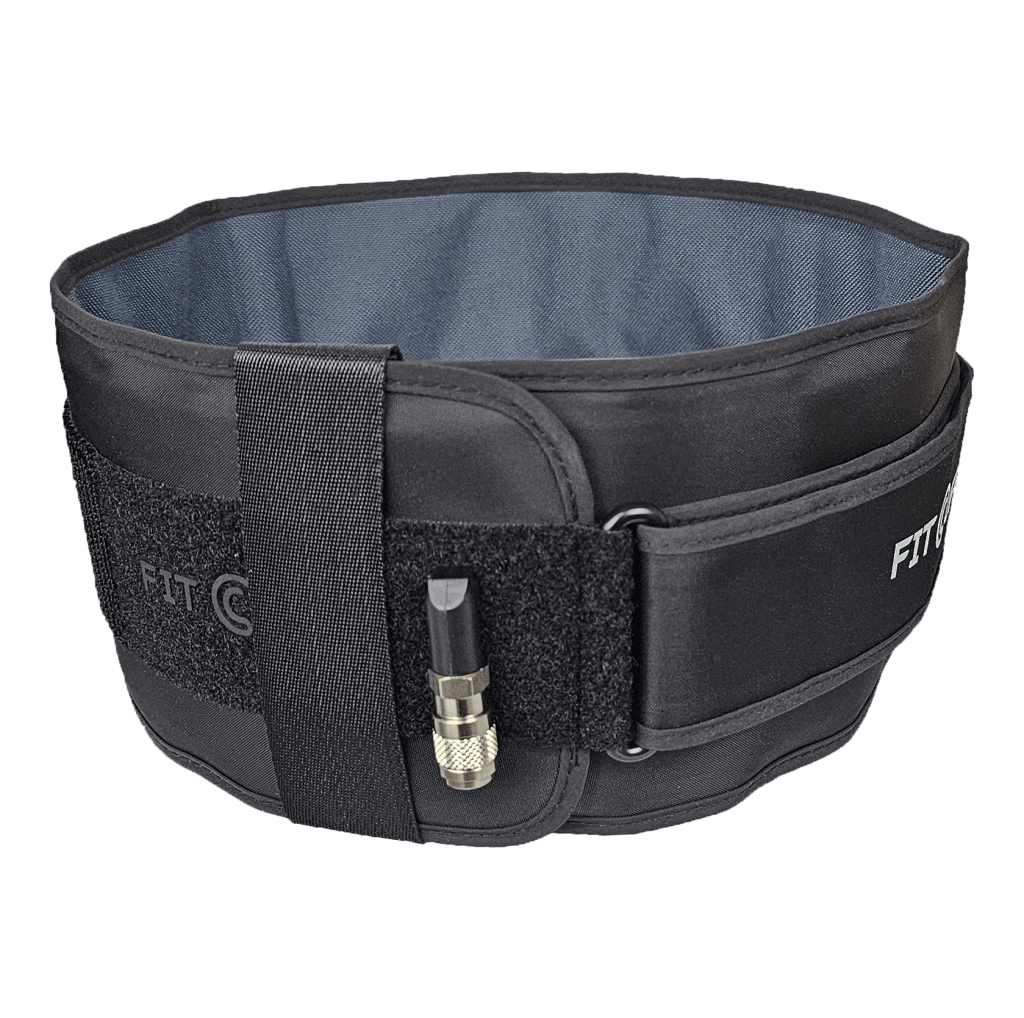

In this video we present yet another set of low practical BFR exercises:
0:00 Step Up. 0:10 Romanian Deadlift. 0:22 Squat. 0:34 Kneeling Squat. 0:44 Reverse Lunge.
During this point of time with many gyms being closed, it becomes inherently more interesting, whether BFR training can substitute conventional high load training?
It seems, that for most people it actually can be just as effective in regards to strength and muscle mass, but tendon health is a less explored field of research.
So, in a new pilot study from University of Copenhagen, the researchers have investigated whether BFR can help to improve tendon health in people with chronic Jumper’s knee (JS).
The rational for using BFR on this population, is that O2 deficiency in the muscle causes lactic acid, that seems to stimulate the formation of collagen protein in the tendon.
Protocol: 7 participants with chronic JP trained 6 sets of both single leg-press and single leg-extension at 30% 1RM until volitional failure for only 3 x 3/weekly.
Results: They experienced about as much progress as normally expected after 12 weeks of heavy slow resistance (HSR) training, which is the current recommended treatment for JS. As, significantly less pain (NRS) was reduced by 50% during single-leg decline squat testing, ultrasound scanning of tendon, showed vascularity diminished by 31 %.
Though, considering the small sample size, it’s very preliminary whether BFR training really has this rapid effect on JS.
If we compare these preliminary findings with the results from Centner et al. (2019), it seems valid that BFR training can be used as the primary modality in the rehabilitation of tendon related pains/disorders such as tendinopathy. But reversely, if we compare this to earlier work by Kubo et al. (2006) they did not find any relevant change on the tendon level. As BFR only increased muscle strength and size without the increment of tendon stiffness or force–elongation, but the high-load leg achieved the desirable improvement in tendon stiffness.
Any thoughts on BFR as the primary training modality or treatment of chronic tendon disorders such as tendinopathy?
Skovlund et al. (2020) The effect of low-load resistance training with blood flow restriction on chronic patellar tendinopathy – a case series.
Centner et al. (2019) similar morphological and mechanical Achilles tendon adaptations compared with high-load resistance training.
Kubo et al. (2006) Effects of low-load resistance training with vascular occlusion on the mechanical properties of muscle and tendon.