

In this post we will explain how progress or regress knee rehab with inspiration from the progressive model for BFR proposed by Loenneke et al. (1)
It seems that passive BFR (BFR without exercise), has the potential to attenuate muscle loss during periods of immobilization (2). Though, for obvious reasons this application is inferior to active modalities.
For the initial stage post-surgery or in some chronic cases, joint swelling and symptoms can be triggered by even low load resistance training. This is especially in such cases that BFR cycling can be the key to regain muscle and mass strength (3).
In the BFR literature, it seems that both continues or interval training can be utilized for hypertrophy and muscle strength (4). But as the muscle specific adaptations seems superior for conventional high intensity training (HIIT) vs. continues, it seems coherent that this is also the case for BFR training. Thus, a single study actually discover the opposite trend (4).
The central paradigm of this ladder-principle, is the reverse nature of progression or regression for early stage rehab vs. prehab, respectively:
Conventional high-load resistance training →
⬆️ Low-Load resistance BFR training, moderate pressure (mmHg) →
⬆️ Very low-load resistance BFR training, high pressure (mmHg) →
⬆️ High intensity interval BFR Cycling →
⬆️ Continuous cardiovascular BFR i.e. steady state walking or cycling →
⬆️ Passive BFR
As described above, we propose that this extended progressive model should be reversed for the general population. That is, if you are able to lift heavy without any pain, conventional exercise should be first line healthcare, but if this is not applicable regress one step, etc.
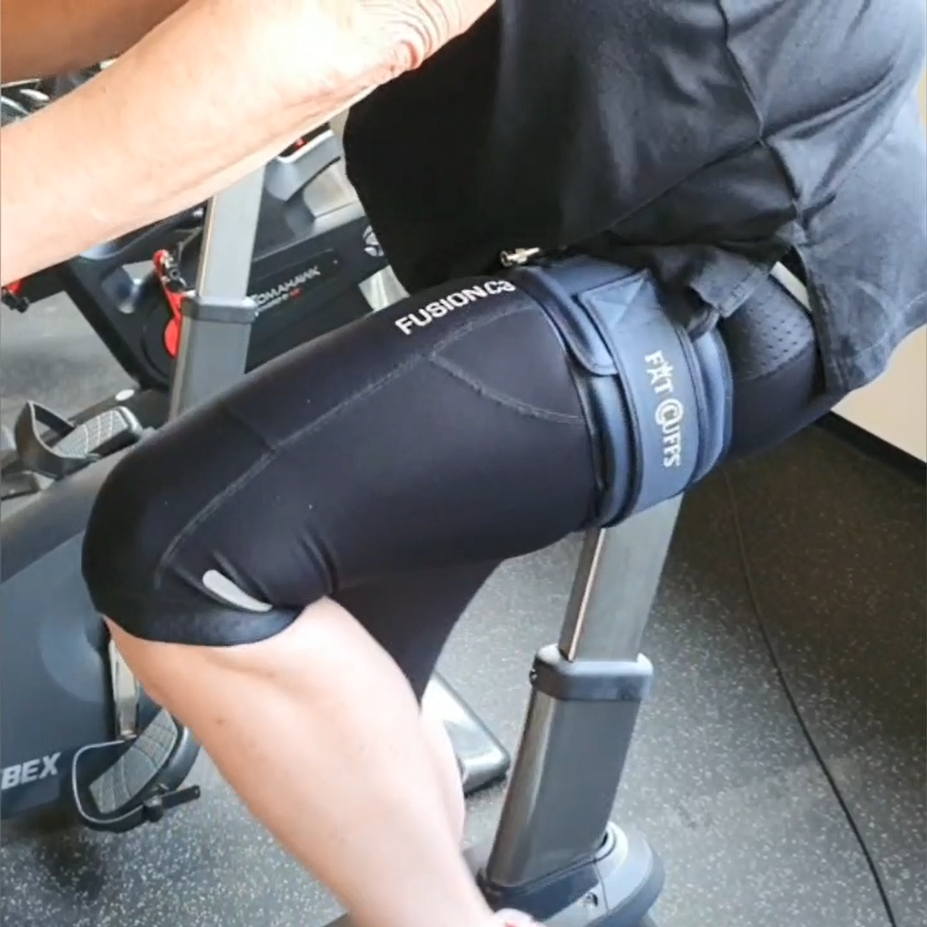
In the video, a woman with a total knee replacement is training with high intensity intervals for late stage rehab, as in her case, even very low-load training is associated with excessive joint swelling.
Source:
(1) Loenneke et al. (2012) Blood flow restriction: An evidence based progressive model (Review).
(2) Barbalho et al. (2019) Addition of blood flow restriction to passive mobilization reduces the rate of muscle wasting in elderly patients in the intensive care unit- a within-patient randomized trial.
(3) Slysz et al. (2016) The efficacy of blood flow restricted exercise: A systematic review & meta-analysis.
(4) Oliveira et al. (2016) Short-term low-intensity blood flow restricted interval training improves both aerobic fitness and muscle strength.