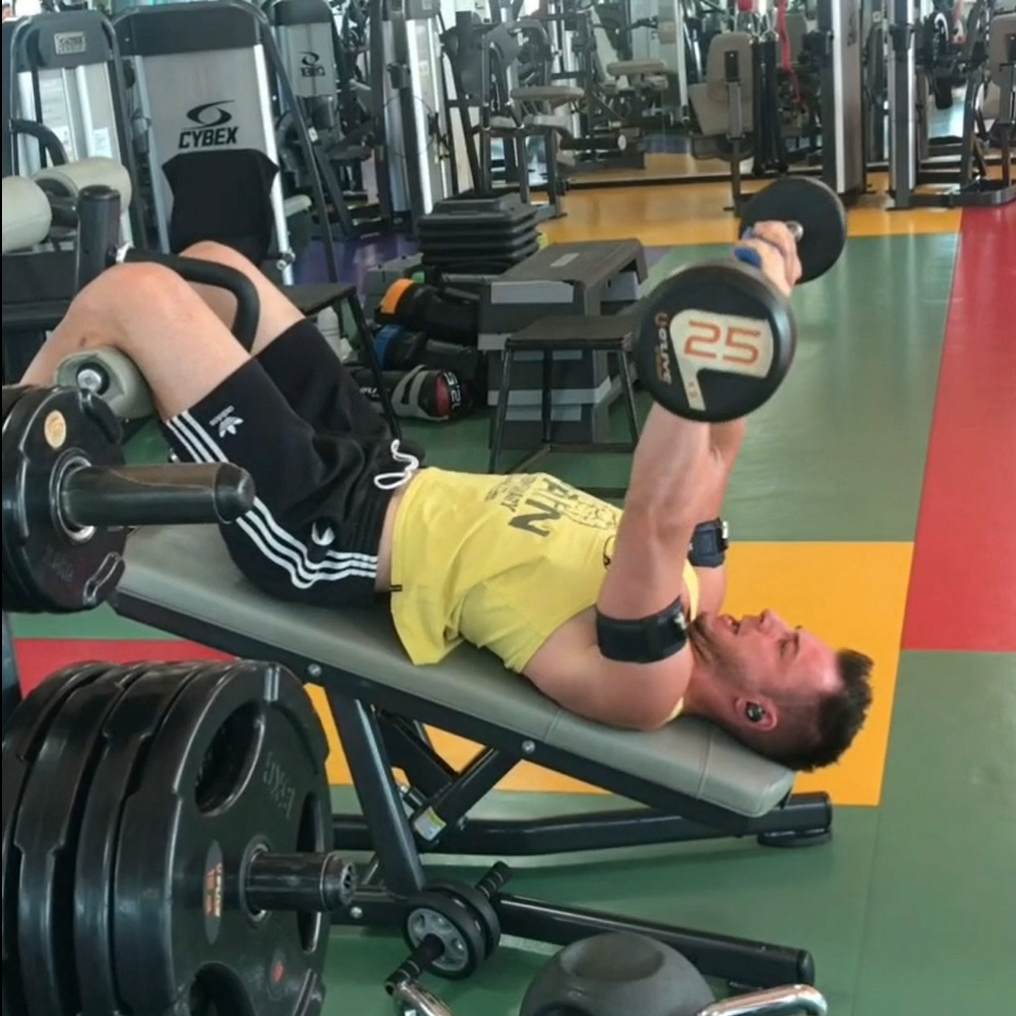


In the video we got a great selection of triceps specific exercises, as this blog post is all about BFR for big arms💪. Covering some of the nerd-alerting physiological mechanisms of low-load BFR in an upcoming post🦾.
As you probably already know, low-load BFR is a great way to increase training volume and frequency without loading the joints or impairing your recovery. For the general public, we recommend to start with your conventional heavy training and finish your workout with BFR as it has some obvious advantages of low-load BFR training, especially in situations of joint pain and high-volume training.
Next, because BFR works best with low-load, use 30-50% of the load you’d usually use for a standard set of 10-15 reps but shorter inter-set rest, as the short rest periods will further increase the rate of exertion and increase the subjective feeling of the pump! You can expect large initial effect, e.g. 2-3 weeks of consecutive training.
When utilizing BFR as a finisher we recommend BFR at a low frequency as only 2-3 times a week with 1-3 upper and/or lower body exercises immediately after performing your main workout as a finisher:
As an alternative to BFR-finishers, is the application of BFR in alternating weeks, swapping with your usual workout routine: We recommend BFR in alternating weeks/days with a high frequency as 1 time per day or even 2 times a day but only for short periods (1-3 weeks).
BFR coupled with low-load exercise increases cell swelling and metabolic stress and let’s your reach the effective rep range faster compared to conventional training and with less mechanical tension.
Source:
Lowery et al. (2013) Practical blood flow restriction training increases muscle hypertrophy during a periodized resistance training programme.
Rolnick et Schoenfeld (2020) Blood Flow Restriction Training and the Physique Athlete- A Practical Research-Based Guide to Maximizing Muscle Size.