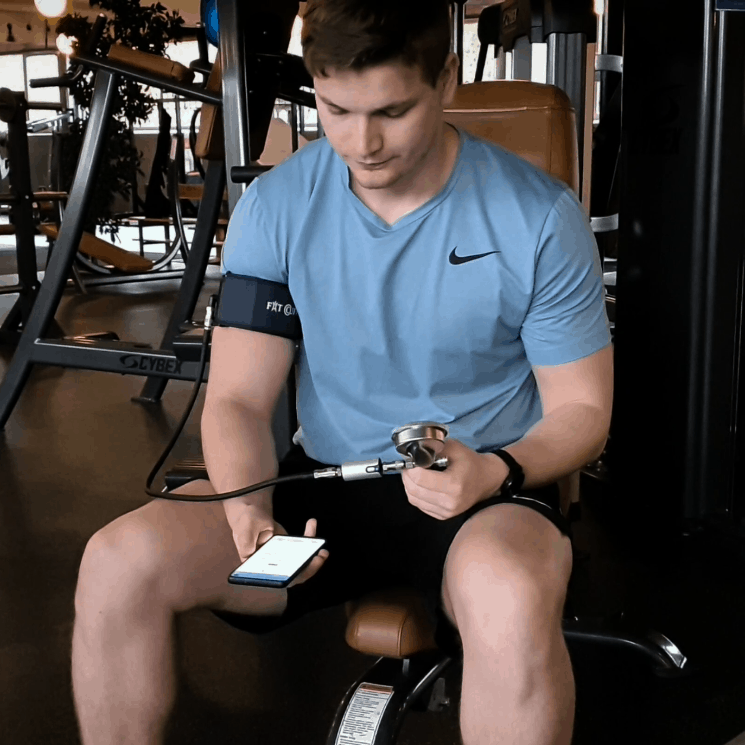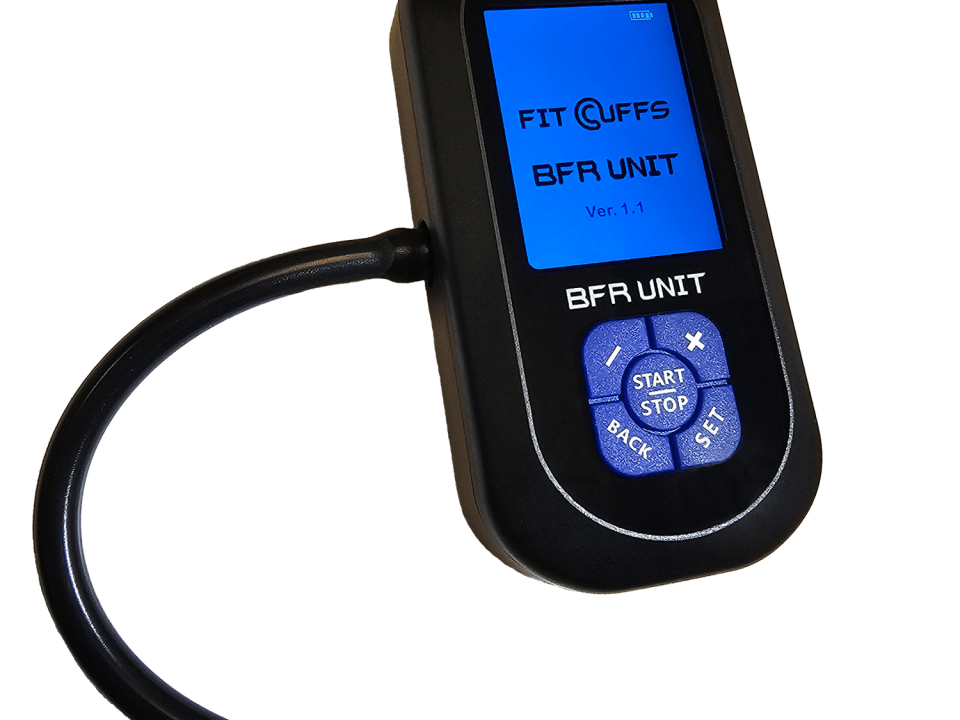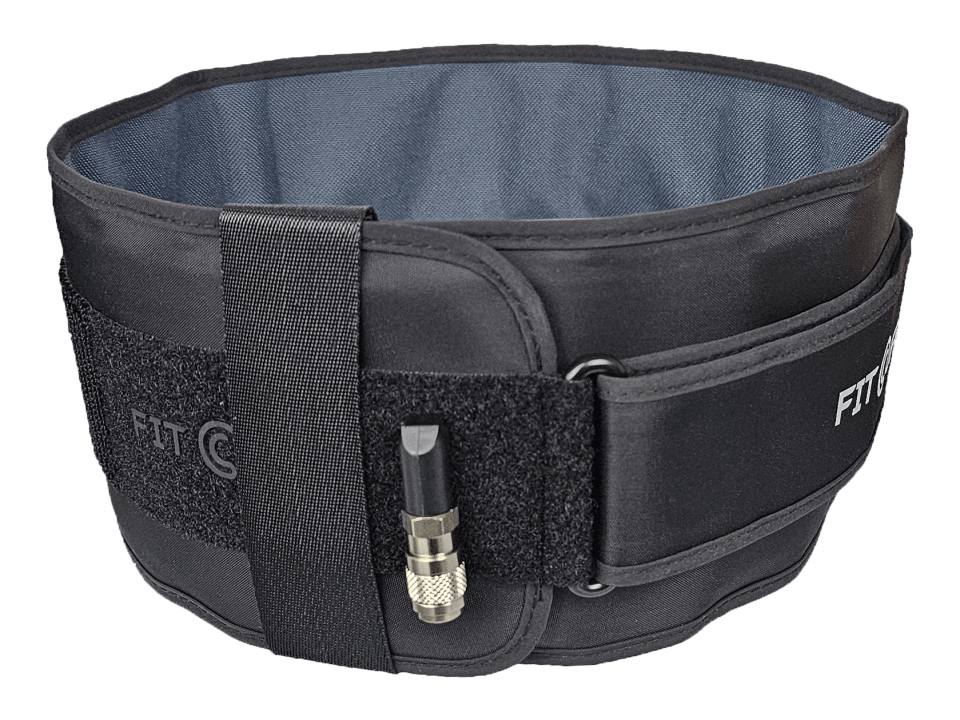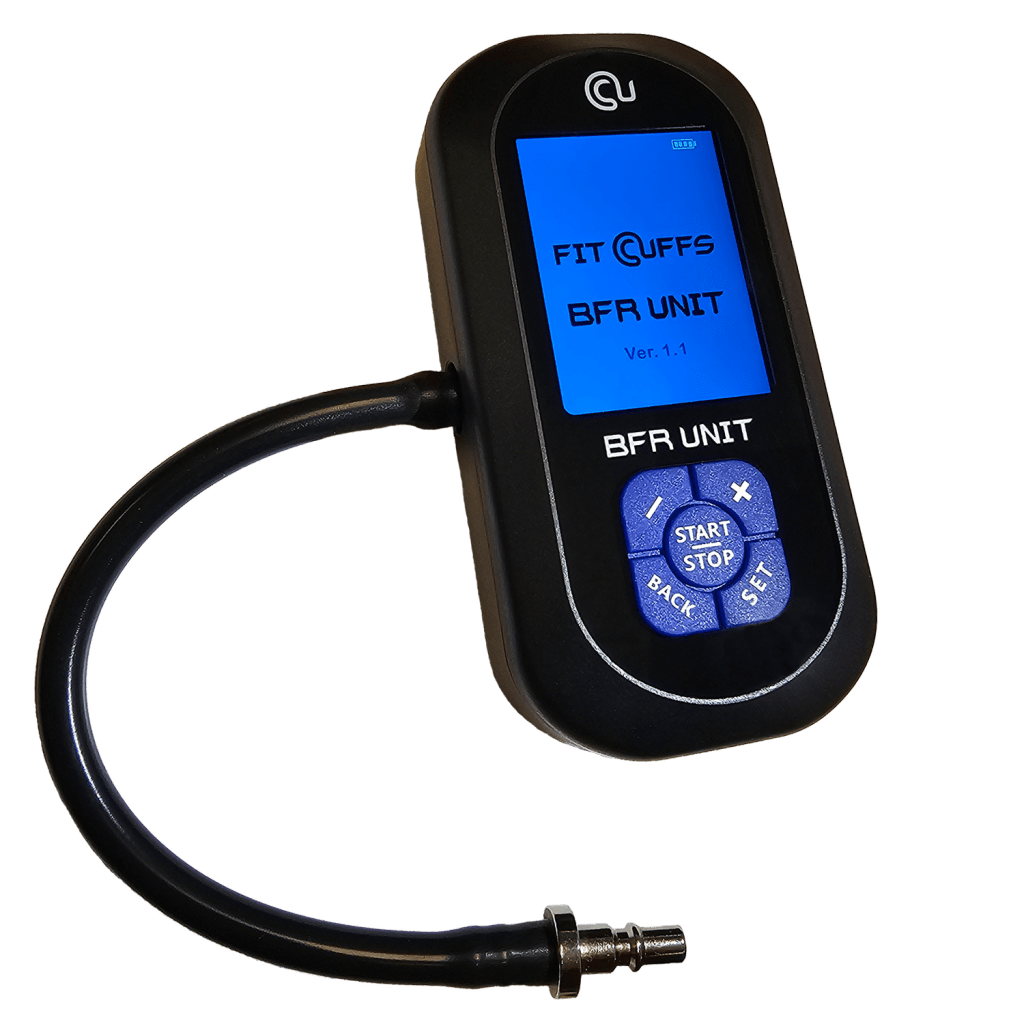

In display we have the new Wireless edition of the pressure gauge assessing Limb Occlusion Pressure (LOP) by the Bluetooth Device and app, which can be imperative for safe applications of blood flow restriction (BFR).
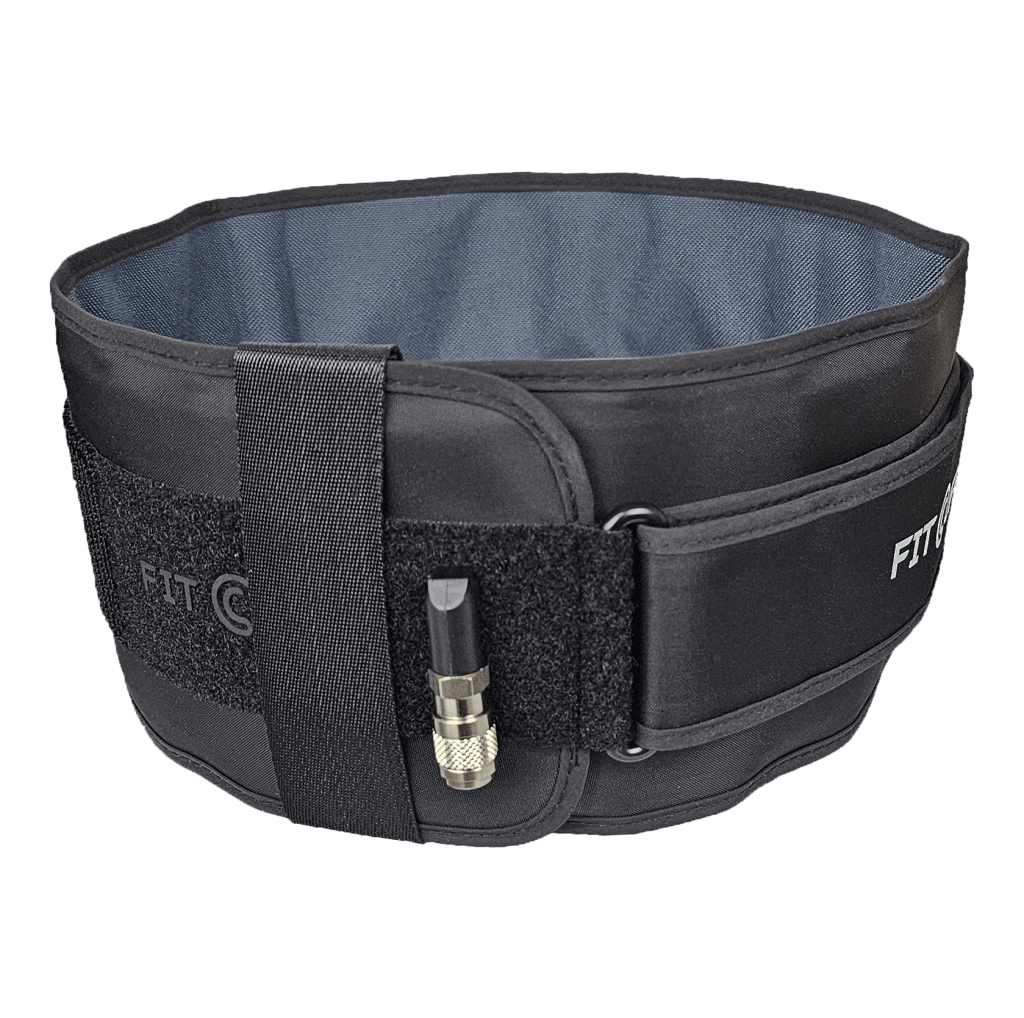
Limb Occlusion Pressure or LOP is the minimum pressure needed to fully block both arterial & venous blood flow. In display 160 mmHg is LOP for this particular person, for that limb, in this position with this exact cuff (Arm Cuff V3).
When preparing for BFR training just set the pressure relative to 100% LOP, but without the Bluetooth Device attached, as this will automatically deflate the cuff.
We recommend to measure LOP in a seated position with the following recommendations for setting the pressure during upper body exercise:
Lying exercise: 40-70% of LOP & seated or standing exercise: 40-80% of LOP. For swift conversions of % to mmHg by our app check the LOP module at training.fitcuffs.com.
“Based on the results of our study, we recommend using the Fit Cuffs® portable Bluetooth Device for objective and personalized BFR practice. This device is a valid, reliable and low-cost replacement for other measurement devices, which are substantially more expensive and require considerable usage skills. Thus, using the Bluetooth Device would offer BFR practitioners the ability to provide high-quality services for their clients or patients, ensuring minimal risks and optimal results regardless of location.” El-Zein (2020).
Nerd Alert – The Bluetooth Device works by oscillometrics i.e, analyzing pulse waves and the absence of pulse waves. This is fundamentally the same as ultra sound by handheld dopplers that detects the absence of blood flow.
– The correct terminology is probably “Arterial Occlusion Pressure” (AOP), but LOP and AOP can for practical applications and explanations be used interchangeably. Total Limb Occlusion (TOP) is another term used in BFR research, this method resolves the problem with hemodynamics i.e., blood pressure variability in relation to external stimuli. So please mind, when doing repeated and continues measurements of LOP on the same limb, readings will vary because of the hemodynamic response to BFR.
Source:
El-Zein (2020) (Thesis) the use of a portable Bluetooth Device to measure blood flow restriction training pressure requirements: a validation study.
Morais et al. (2016) Upper limbs total occlusion pressure assessment; Doppler ultrasound reproducibility and determination of predictive variables.
Loenneke et al. (2014) Blood flow restriction in the upper and lower limbs is predicted by limb circumference and systolic blood pressure.
Zachary et al. (2020) Limb Occlusion Pressure: A Method to Assess Changes in Systolic Blood Pressure.
Disclaimer: When assessing conventional blood pressure, you should always use a calibrated cuff, i.e., width of the cuff relative to the circumference of the limb you are assessing. That is why you can not use Fit Cuffs product selection to measure “blood pressure” and this combined unit is only valid for assessment of LOP.