

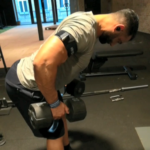
This post is about the width and material properties of BFR cuffs and how this effect different physical parameters and perceived discomfort.
A newly published review on BFR and discomfort concludes that particularly for the upper body, narrower cuffs seems to be favorable as wider cuffs seems to increase discomfort during exercise (1). For the general public and healthcare this is of huge importance as the adherence to exercise or rehabilitation is imperative for effect regardless of goal setting.
Though, there is a range of tradeoffs or pros and cons to consider when choosing the right cuff width:
Narrow cuffs require higher absolute pressures to elicit the same relative pressure which can inhibit estimation of LOP and increase compression into the underlying tissue (2). The relative fluctuation of pressure and mechanical compression during muscle contractions is also larger.
On the other hand, narrow cuffs allow for more freedom of movement and even though the localized pressure is higher, a smaller area of the muscle is affected by this which seems of importance (1).
During the prolonged development of Fit Cuffs into it’s current form, the cuff material has also been discovered as extremely important especially for the upper body, Thus, the research has yet to confirm this point (3).
Since muscle contractions in the upper arm expands the girth relatively more compared to the upper leg, a stiff material is not alone discomfortable, but also hinders muscle contractions and in extreme cases can lead to tissue damage (1,2).
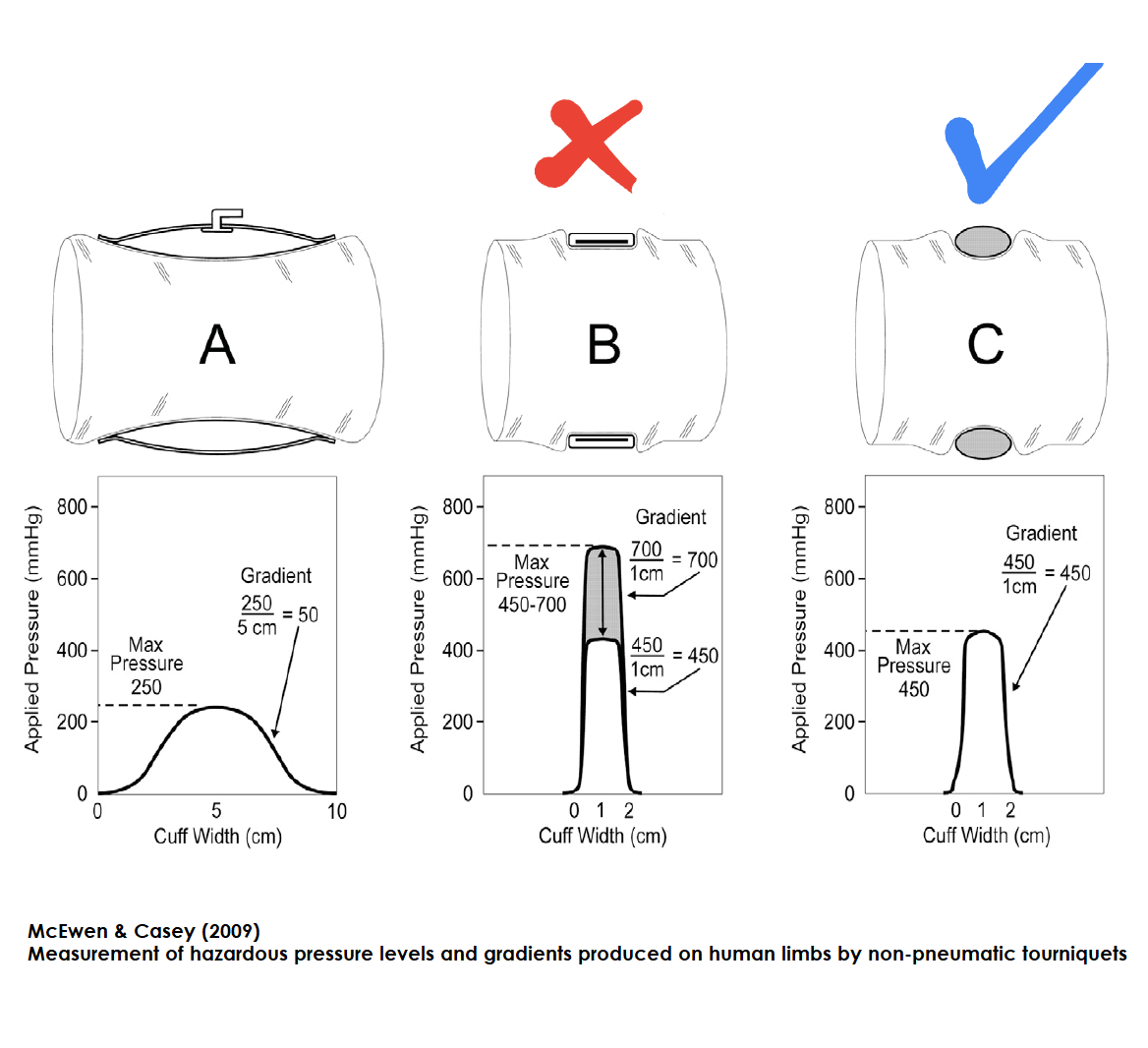
For a visualization of the inherent properties of different cuff material, see the figure from Mcewen & Casey (cuff type B vs C). This is also why Fit Cuffs is designed with differentiated properties with the upper body cuffs being more pliable.
Source:
(1) Spitz et al. (2020) Blood Flow Restricted Exercise and Discomfort A Review.
(2) Mcewen & Casey (2009) Measurement of hazardous pressure levels and gradients produced on human limbs by non-pneumatic tourniquets.
(3) Buckner et al. (2016) Influence of cuff material on blood flow restriction stimulus in the upper body.