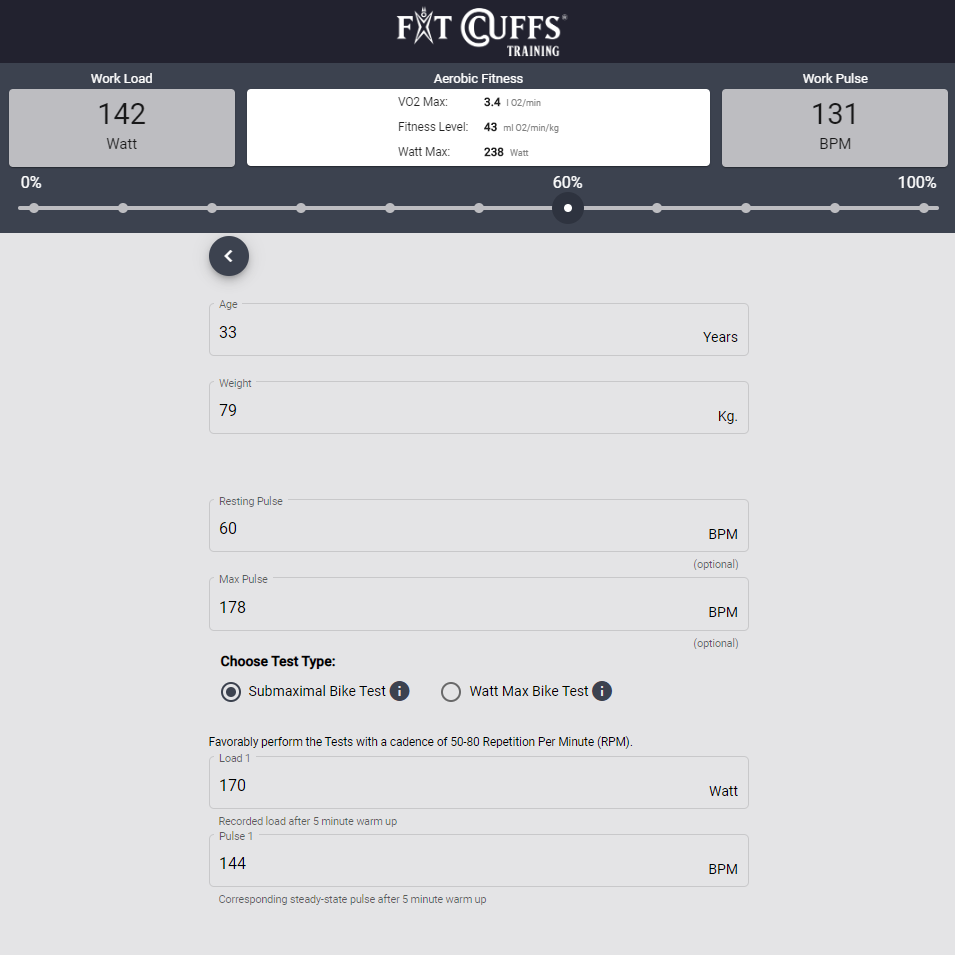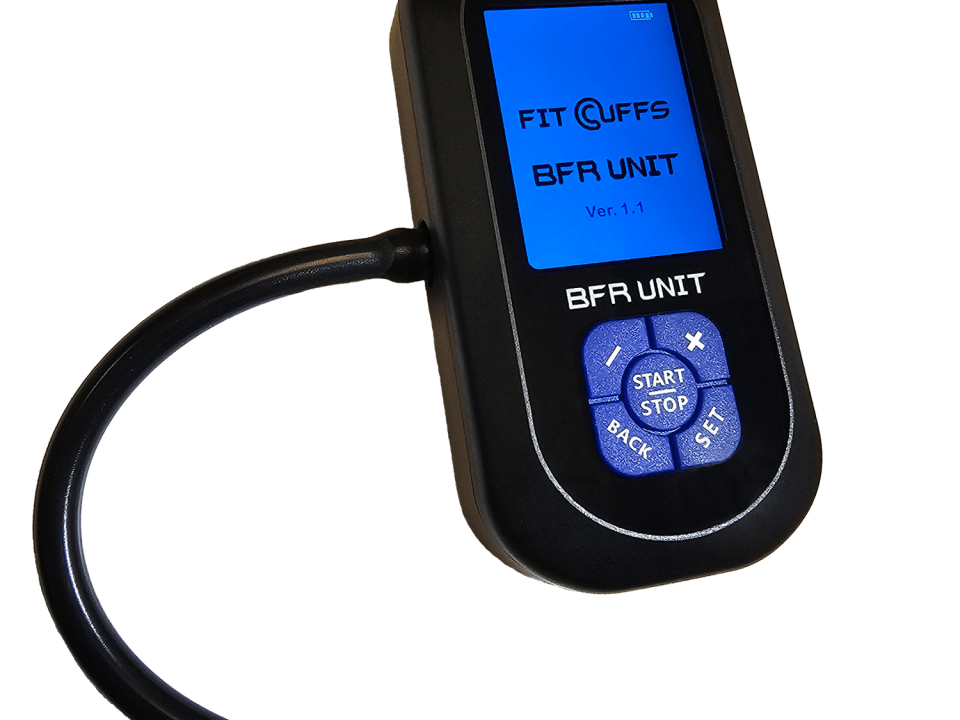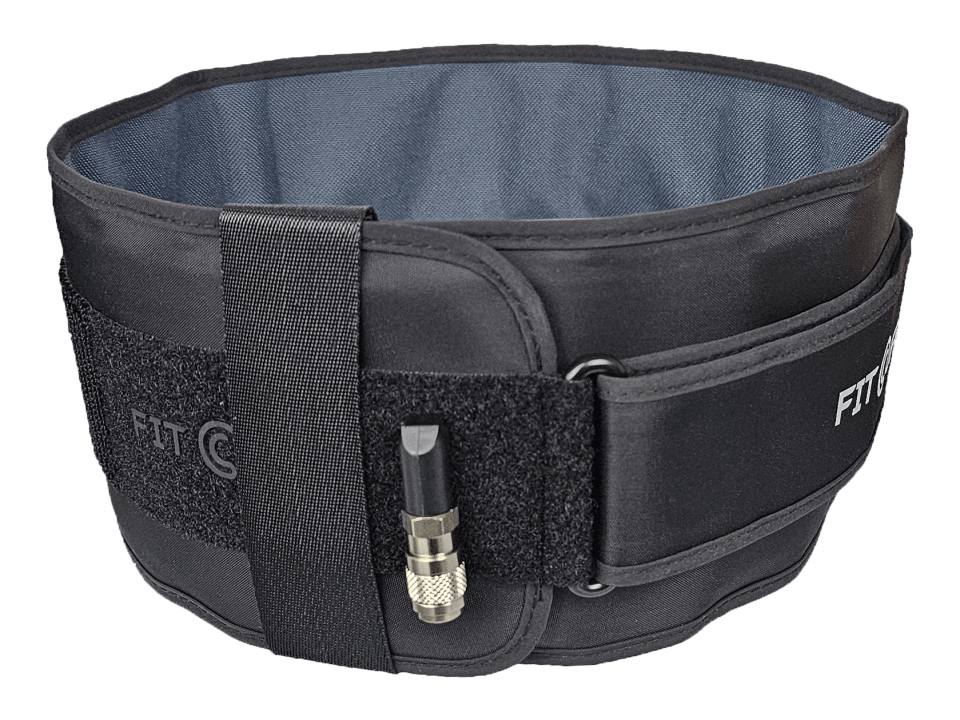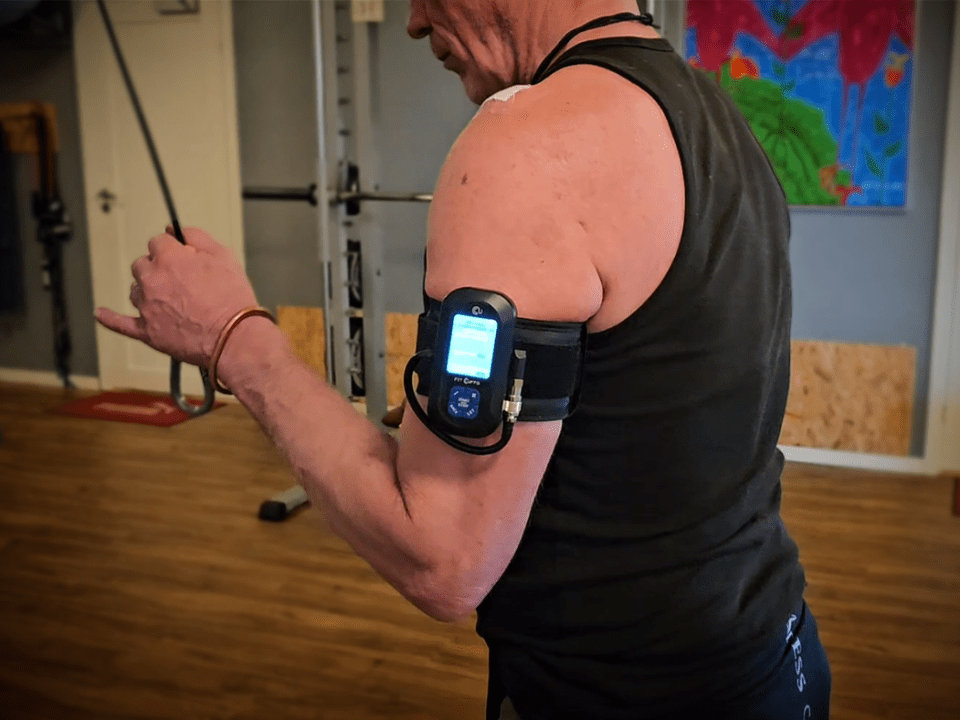


This is the follow-up for the latest blog on the new Aerobic Fitness module, that can be used to set intensity relative to Watt Load or Work Pulse with or without BFR.
Additionally, the Bike Tests can be used to predict VO2 Max, Fitness Level and Watt Max, which is commonly known as “indirect tests” for Aerobic Fitness. A comprehensive protocol for each test can be located directly at training.fitcuffs.com –> “Bike Tests”.
Many clinician and trainers are interested in determining an individual’s Aerobic Fitness but are limited in their use of “direct tests”. The tests can be performed on any type of exercise bike but preferable on a Watt-bike Cycle Ergometer. Subsequently, you can use the build-in slider to set the intensity relative to either Watt Load or Work Pulse Beats Per Minute (BPM) i.e. Heart Rate Reserve (HRR).
The features consist of 3/4 different tests build into the same interface. All tests seem to have less than 10% error associated with them in predicting VO2 Max (1) and a very high ability to detect any relevant change of Aerobic Fitness:
a. By only using Age, the app will estimate your Max Pulse and Resting Pulse. This is sufficient to use the slider-functionality to set the intensity relative to HRR i.e. BBP. For a more precise estimation of your HRR you can add your Max Pulse and Resting pulse.
b. The Submaximal Bike Tests includes a rather simple “one-point-test”, that can be used to estimate your VO2 Max, Fitness Level and Watt Max. To use this feature, you need to find your steady-state-pulse at a corresponding Watt Load, i.e. Load 1 and Pulse 1. Add your Resting Pulse and Max Pulse to obtain a more valid estimation of your actual Aerobic Fitness (2,3,4).
c. For improved estimation of your Aerobic Fitness, you can perform the same test but adding a higher load and higher pulse i.e. Load 2 and Pulse 2, aka. “two-point-test” (2,3,4).
d. But the Golden standard for most individuals is the Watt Max Bike Test. This is performed by a similar progressive protocol, but this test is much harder as you must go all out and reach the point of absolute failure in order to obtain a valid test result. this maximum test, should not be used in at risk populations i.e. heart or respiratory conditions, without approval from a physician. As a rule of thumb for the general public, if you’re not used to do strenuous exercise, perform the test after gradual exposure to near maximal intensity aerobic exercise.
Disclaimer: Always consider the safety of the tests in respect to age, training condition, etc., and the test–retest reliability and validity (1). The formulas from the Bike Test module can be found at (4).
Source:
(1) Grant et al. (1999) The Prediction of Vo2max: A Comparison of 7 Indirect Tests of Aerobic Power.
(2) Astrand et Rodahl. (1986) Textbook of Work Physiology: Physiological Bases of Exercise (3rd ed.). New York.
(3) Astrand et Ryhming. (1954) A nomogram for calculation of aerobic capacity (physical fitness) from pulse rate during submaximal work.
(4) Beyer et al. (2010) Træning – i forebyggelse, behandling og rehabilitering. Munksgaard Danmark.