
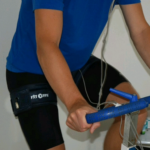
In this video we present 6 exercise blood flow restriction (BFR) variations for the rotator cuff muscles (RCs).
0:05-Flexion. 0:12-Abduction. 0:20-External rotation (ER) at 0°. 0:30-Internal rotation (IR) at 0°. 0:39-IR at 90°. 0:46-ER at 90°.
We find this interesting as a relatively new paper (only preliminary results presented), discovered that BFR for low-load resistance exercise to be effective for proximal gains i.e. RCs (1).
PURPOSE: If BFR promote greater increases in strength, muscular endurance, and lean mass for the RCs compared to exercise alone (No-BFR). Secondly, if BFR during acute low-load resistance exercise increases activation of RCs.
METHODS: (RCT) Eighteen healthy adults randomized into 2 groups (BFR vs. No-BFR).
Each group: 8 weeks (2/wk) as 4 low-load RCs resistance exercises at 20% of 1RM: Cable – external rotation (ER) & internal rotation (IR). Dumbbell – scaption & side-lying ER.
1 set/30reps followed by 3 sets/15reps (30s inter-set rest, 2min inter-exercise rest). For progression, 1lb (0.45 kg)/week if all repetitions where achieved.
Only BFR: Intermittent BFR stimuli (only during exercises) at 50% LOP.
RESULTS: Lean Mass: Arms BFR vs No-BFR, 8.15% vs. -0.43%, respectively. Shoulders BFR vs No-BFR, 28.10% vs. 11.23%, respectively.
Strength: Assessed in 6 different positions comparing dominant and non-dominant arm separately: For the dominant arm, all positions showed a strong trend for BFR be superior. ≈ 5-20% greater relative improvements for BFR vs. No-BFR.
Exercise Volume: 7/7 follow-up tests in favor of BFR.
Mean EMG activations: Same relative activation pattern for Infraspinatus, but BFR seemed to be superior for Teres Minor.
CONCLUSIONS: BFR augmented RCs exercises seems favorable. Possible due to a greater activation of shoulder musculature.
Discussion: The exercise intervention was designed in favor of BFR. The load was only 20% 1RM with a standardized rep-scheme and only allowed for 1lb (0.45 kg) once/week for progression. – Any thoughts?
An interesting sub-finding was that only the dominant arm for the BFR-group experienced a greater relative improvement in strength. – Any thoughts?
Source: Lambert et al. (2019) B.F.R. For Proximal Benefit: Blood Flow Restriction Therapy For The Shoulder?