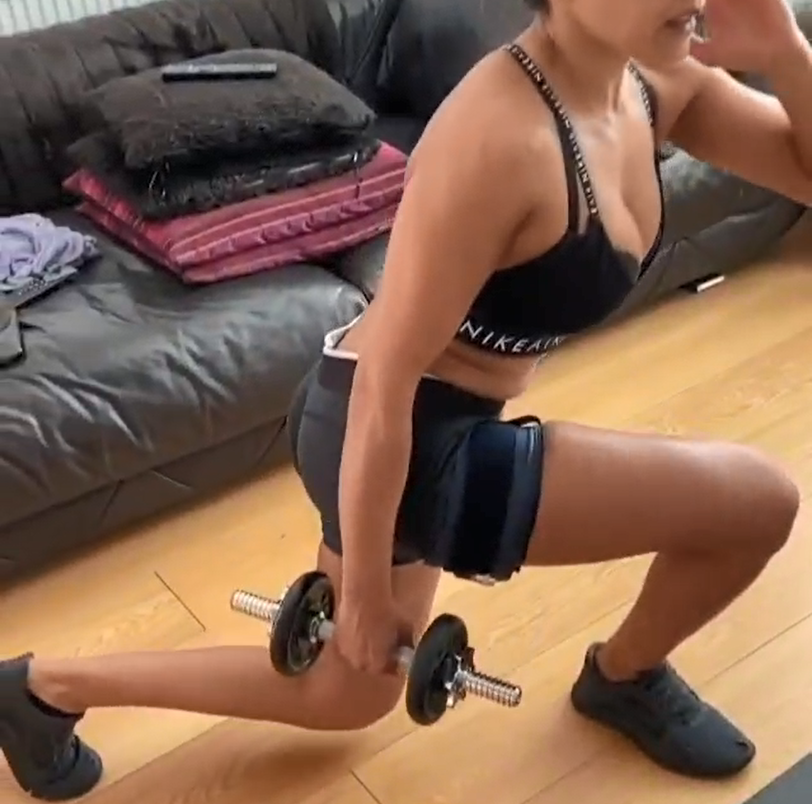



Even though gyms around the world are opening again, home-BFR is equally as swift, effectful and convenient. So, In this post we got another selection of classic compound exercises that works most of the lower body:
0:00 Back Squat – 0:20 Cross-behind Lunge. – 0:40 Romanian Deadlift.
Cross-behind lunge focuses on strengthening the glutes, quads, and calves. It has also been proposed that the large range of motion of the hip, augments glute strength and muscle gains.
Though, the glute muscle is obviously upstream relative to the cuff (proximal), it appears that BFR is effective for improving glute size and strength, when neither clinical or practical feasible to use higher loads.
Proximal hypertrophy is a common observation in multi-joint BFR training exercises in both aerobic and resistance training protocols, but the reasons for hypertrophy of the gluteus are unclear and several explanations exist.
If we compare the rational for proximal gain of the glute in the BFR-Squat vs. BFR-Romanian deadlift, it can be speculated that the underlying mechanisms are somehow different:
The accelerated fatigue of the muscles distal to the cuff require a larger contribution of the muscles proximal to the cuff. Because of a higher motor unit recruitment may be required to maintain sufficient force generation as a synergistic action of the knee and hip muscles that increases the demand of the proximal muscles.
This is the most common explanation of why the conventional BFR-squat movements can be effective for proximal gains. – With the glutes being the prime hip extensors in the squat, and hamstrings being secondary, i.e. stabilizers of the knee, the magnitude of proximal effect is probably attenuated by the rapid fatigue of the quads and thereby the limiting factor.
For the hinge pattern e.g. Romanian deadlift, the knees are almost fully extended causing the hamstrings to be a prime mover along with the glutes. But when you pair this movement with BFR, it can be hypothesized that the hamstrings get fatigued faster compared with No-BFR deadlifts, making the glutes the primary hip extensor and reaching it’s full potential for growth.
Source:
Bowman et al. (2019) The Proximal and Distal Effects of Blood Flow Restriction Therapy on Upper and Lower Extremity Strengthening: A Randomized Controlled Trial.
Abe et al. (2005) Skeletal muscle size and circulating IGF-1 are increased after two weeks of twice daily “KAATSU” resistance training.
Luebbers et al. (2014) The Effects of a 7-Week Practical Blood Flow Restriction Program on Well-Trained Collegiate Athletes.