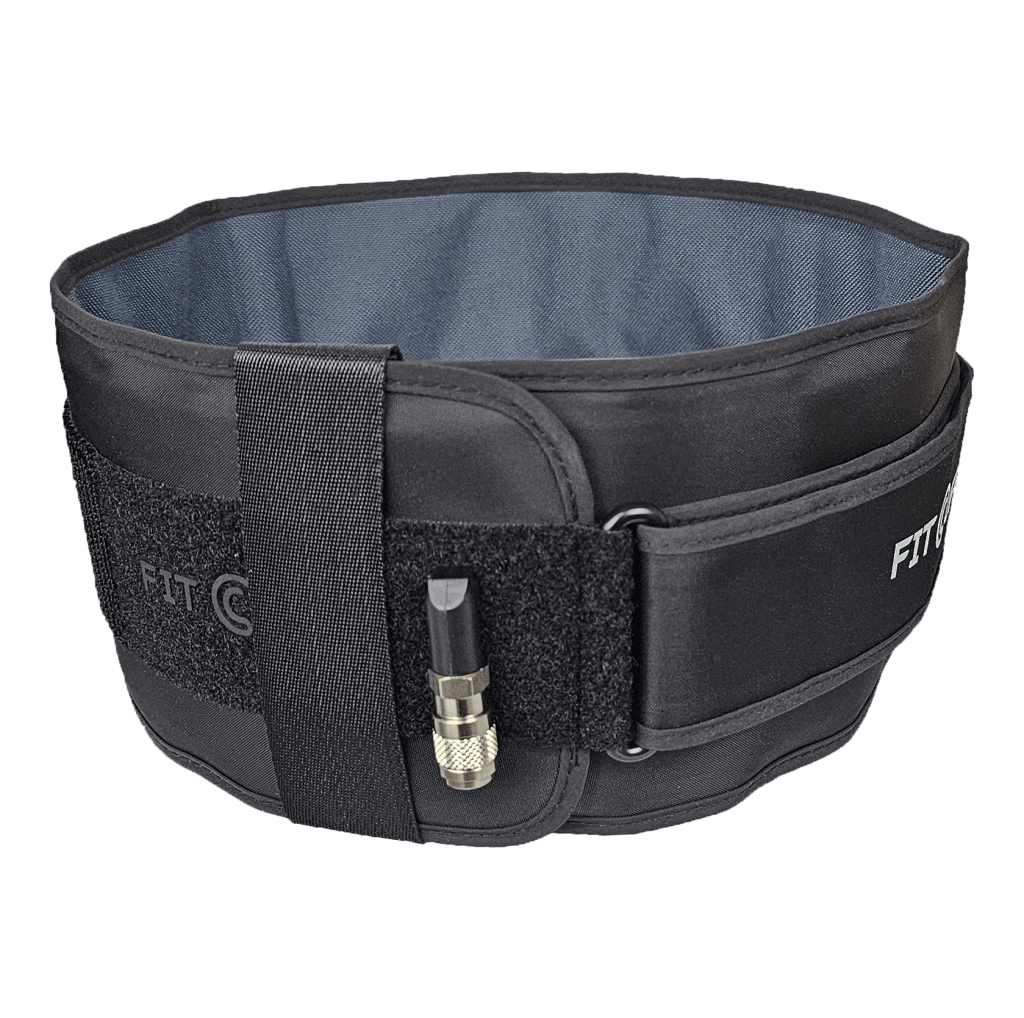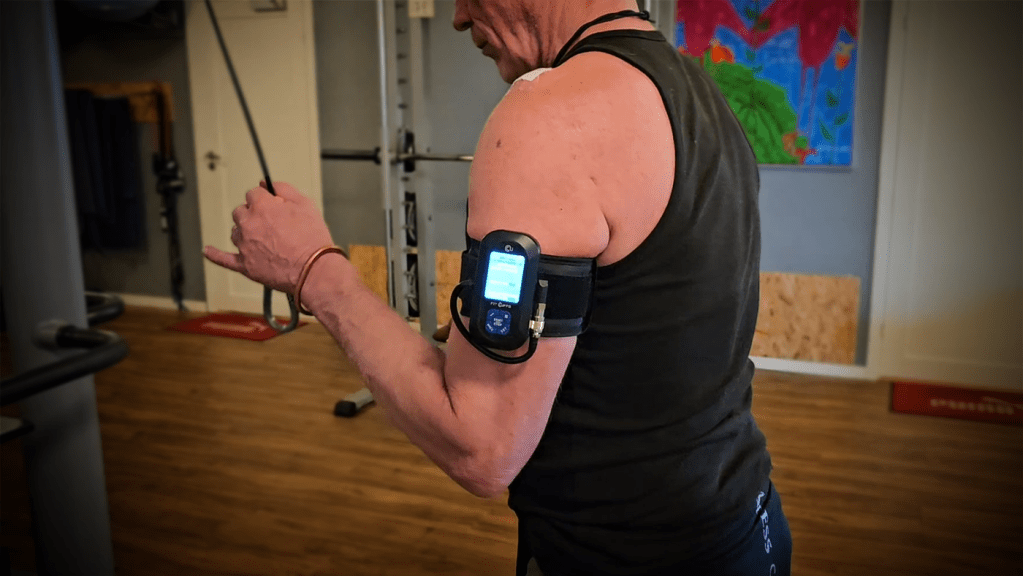


BFR for Total Knee Arthroplasty (TKA)⬇️
It seems that BFR prehab training can improve outcomes for Total Knee Arthroplasty (TKA).
📄A relatively new pilot study exploring the possible effect of BFR Training before TKA (prehab). I.e., can BFR used only pre TKA attenuate atrophy and improve function post-TKA!?
➡️Introduction:
It is important in TKA’s to mitigate the decline in strength, muscle mass, and functioning. Though, conventional resistance training (RT) is often not well tolerated preoperatively and prohibited in the acute to sub-acute phase post-op.
🔳Aim:
Explore the feasibility and acceptability of BFR Training in the preoperative period for patients awaiting TKA.
🔩Methods:
Patients undergoing TKA were randomized to either BFR exercise for 4 weeks before surgery vs standard care (no exercise).
BFR group: 2/weekly as 2 sets of each exercise to volitional failure: leg press, leg extension, leg curl, and calf raise at 30% 1RM.
Pressure (mmHg) set as: 0.5(SBP) + 2(thigh circumference) + 5.
📐Outcomes:
Baseline; 4 to 5 weeks preoperatively and follow-up; 2 weeks postoperatively.
📌Physical function – Short Physical
📌Performance Battery (SPPB).
📌6-Minute Walk Test (6MWT).
📌Leg strength (peak torque).
📌Numerical Pain Score (NPS).
📏Secondary outcomes:
📌Patient acceptability as the rating of exertion (Borg CR10)
🤷🏽♂️Patients’ ratings of “pleasantness” of exercise 0-100!?
📊Results:
BFR group: less decline in SPPB following surgery (-2.2,) VS No-BFR (-4.8). No differences for the 6MWT, peak torque, and NPS.
No complications and full compliance were observed as a proxy for the feasibility and acceptability of BFR.
Discussion:
The study was not powered (few participants and small expected outcome difference) for statistical comparison of the 2 groups. It can also be speculated that the volume load was underdosed as 2/weekly with 4 different exercises but only 2 sets of each, as the body of evidence seems to favor 3-4 sets of each exercise. And importantly, it would be of higher clinical relevance comparing BFR vs similar exercises without BFR.
It seems obvious that muscle strength and size for the postoperative phase (rehab) is of greater importance than BFR used only as prehab because of the expected “return to the mean”. So, it would be interesting to explore if BFR-prehab can accelerate functioning when also used as rehab!?
Either way, stay tuned for the results of an ongoing study with about 150 participants on BFR Training vs Standard PT After Total Knee Arthroplasty
Primary Source:
Przkora et al. (2021) Blood flow restriction exercise to attenuate postoperative loss of function after total knee replacement: a randomized pilot study.
Secondary Source:
BFRT vs Standard PT After Total Knee Arthroplasty (BFRT-TKA) – Only protocol ATM: clinicaltrials.gov/ct2/show/NCT04366336
Wengle et al. (2021) The Effects of Blood Flow Restriction in Patients Undergoing Knee Surgery: A Systematic Review and Meta-analysis.