
The Complete Research-Based Guide For Blood Flow Restriction (BFR) Training
General Recommendations & Safety Measures ⇩
Cuff Placement

Only Proximal At The Arm OR Proximal At The Thigh
Assess Limb Occlusion Pressure

Use 40-80% LOP OR Use The Calculate Pressure Module At training.fitcuffs.com

Gradual Exposure Prioritized In The Following order

Increase Restriction Time

Increase Repetitions, Sets Or Exercises

Progress Load Or Intensity (kg or Watts)

Maybe Slightly Increase Cuff Pressure (mmHg) (<80% LOP)

Safety Concerns In At-Risk Populations

Assess Risk Factors & Contraindications: Bond et al. (2019) & Patterson et al. (2019)

Short Restriction Time Or Deflate (mmHg) Between Sets (Intermittent BFR)

Measure Limb Occlusion Pressure (LOP) / AOP & use Low Pressure (40-50% LOP)

Physician Approval for BFR
Assess Pressure (mmHg) During Exercise

Be Aware Of Dizziness Numbness, Discomfort, etc.
Pescription of BFR With Resistance Training ⇩
Frequency

2-3 Times a Week (>3 Weeks) or 1-2 Times Per Day (<3 Weeks)
Load

20-50% of One Repetition Maximum (1RM)
Rep Scheme
1-3 Exercises, 2-4 Sets, Reps 30x15x15x15 or Failure
Time

<15 min if Continuous BFR Or Deflation Between Exercise (No BFR Inter-Exercise)
Rest

Inter-Set: 30-60 Seconds, Inter-Exercise: >1min
Pressure

Intermittent (No BFR Inter-set) or Continuous At 40-80% LOP

Why Use BFR With Resistance Training?

Gain Strength & Muscle Size When High-Load Training is Not Possible Or Painful

Use As Supplement To Concurrent High-Load Training
Prescription of BFR With Aerobic Exercise ⇩
Frequency
2-3 Times a Week (>3 Weeks) or 1-2 Times Per Day (<3 Weeks)
Intensity

30-70% VO2 Max or Heart Rate Reserve (HRR) or Watt-Max
Time
<20 min As Continuous Steady State or Interval Training
Pressure
40-80% LOP As Continuous orintermittent pressure (mmHg)
Exercise

Ergometer Cycling, Exercise Bike Walking, Running, Stair Climbing, Rowing, etc.
Why Use BFR With Aerobic Exercise?

Improve Performance e.g. VO2-max, Strength, Muscle Size & Endurance

As a Part of Early Phase Rehab For Load Compromised Individuals

Increase Skeletal Muscle Capillaries
Prescription Of Passive BFR ⇩
Frequency
1-2 Times Per Day Or Pre/Post Strenuous Training
Time & Intervals
3-5 Intervals – 3-5 min Inflation Followed by 3-5 min Deflation
Pressure
80-100% Limb Occlusion Pressure (LOP)
Timing

Ischemic Pre/Post Conditioner: 1-2 Hours Before/After Relevant Activity
Why Use Passive BFR?

To Attenuate Muscle Loss After Surgery or Severe Injury

To improve Sports performance known as Ischemic Pre Conditioner (IPC)

To improve Recovery after exercise known as Ischemic Post Conditioner
BFR With Concurrent Conventional Exercise ⇩

Resistance Training or Aerobic Exercise Relative to Goals & Concurrent Training
Alternating as 1-3 Times Per Week

Used Following Days of Strenuous Training Or A Game
Why BFR With Concurrent High-Load/Intensity Training?

Faster Restitution Compared To Conventional Exercise

Augment the Effect Of Conventional Training & Exercise Programs

Maintain Strength & Muscle Mass With Concurrent High Volume Training
Additional Content ⇩

Model For Progressive Rehab with BFR

Passive BFR (80-100% LOP) & BFR-Walking (40-80% LOP)

Continuous Aerobic BFR Exercise i.e. Steady State: 40-60% Relative To VO2max, HHR or Watt-max

Very Low load Resistance BFR Training (<2O% 1RM) + High Pressure (70-80% LOP)

Higher Intensity Interval Aerobic BFR Exercise: 60-80% Relative To VO2max, HHR or Watt-max

Low-moderate Load Resistance BFR Training (25-50% 1RM) + Moderate Pressure (40-60% LOP)

BFR To Improve Sport & Athletic Performance
Sprint Speed – Near maximal Effort (6O-80% Max Velocity) with 30-6O s. Inter-set-rest 20-100 Meter Sprints + Continuous Pressure
Continuous Aerobic: 50-70% Relative To VO2max, HHR or Watt-max
Time to Exhaustion / Endurance: 60-100% Relative to VO2max, HHR or Watt-max. 1-5 min Intervals Inter-set Rest Without Pressure

Anaerobic Performance As 1-3 min Intervals With 30-60 s. Inter-set Rest Without Pressure. Progressively Higher Intensity (60–>90%) relative to VO2max + 60–>90% LOP
Primary Source
Bond et al. (2019) Blood Flow Restriction Resistance Exercise as a Rehabilitation Modality Following Orthopaedic Surgery: A Review of Venous Thromboembolism Risk.
Patterson et al. (2019) Blood Flow Restriction Exercise, Considerations of Methodology Application, and Safety.
Loenneke et al. (2012) Blood Flow Restriction: An Evidence Based Progressive Model (Review)
Barbalho et al. (2019) Addition of Blood Flow Restriction to Passive Mobilization Reduces the Rate of Muscle Wasting in Elderly Patients in the intensive Care Unit: A Within-patient Randomized Trial
Rolnick et Schoenfeld (2020) Blood Flow Restriction Training and the Physique Athlete- A Practical Research- Based Guide to Maximizing Muscle Size.
Bennet et al. (2018) Effects of Blood Flow Restriction Training on Aerobic Capacity and Performance a Review
Amani et al. (2019) Effects of Blood Flow Restriction and Exercise Intensity on Aerobic, Anaerobic, and Muscle Strength Adaptations in Physically Active Collegiate Women
Behringer et al. (2017) Low-Intensity Sprint Training With Blood Flow Restriction Improves 100-m Dash.
Christiansen et al. (2019) Cycling with blood Flow restriction improves performance and muscle K+ handling and blunts the effect of antioxidant infusion in humans

Featured products
More than 6000+ units sold
-
Fit Cuffs | BFR Course | Complete
Original price was: 854 €.632 €Current price is: 632 €.➤ (Update 2024) Blood Flow Restriction – All 4 Courses One Major Package. +13 Module Online Video BFR Training Course by Dr. Nicholas Rolnick PT, MS, CSCS. Help more patients with BFR training & learn how to implement BFR Training safely and effectively with the 11.5 hour online BFR certification training course (11.75 total CEUs). Within 24-48 hours after purchase You will receive a link for the course. – Read more below
Included:
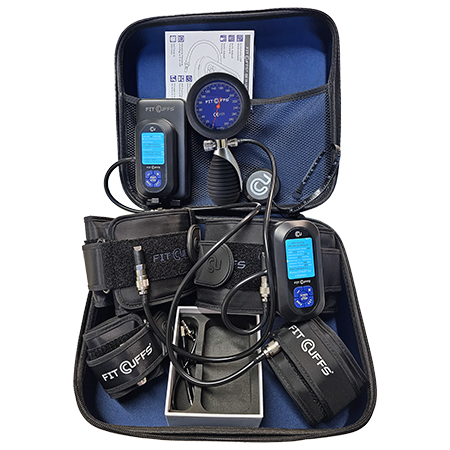
Fit Cuffs – Complete
➤ 2 x Leg Cuffs V5.0, V3.1 Or V4.0 (45-85 cm / 17.7-33.5 Inch)
➤ 2 x Arm Cuffs V3.1 Or V4.0 (20-50 cm / 7.9-20 Inch)
➤ Pressure Gauge
➤ 2 x Deflation Plugs + Measurement Tape
➤ (Optional) BFR Unit & Power Bank</p>
➤ Large Hard Carrying Case – dimensions tailored to accommodate contents -
Fit Cuffs | BFR Unit | Complete
Original price was: 713 €.445 €Current price is: 445 €.Includes
➤ 1 or 2 pcs. Fit Cuffs® BFR Unit V1.1 + Standard Length Tube (50cm / 19.6 Inch) (Basic) – Optional: in Hard Case + Long Tube (2 meter / 79 Inch)
➤ 2 x Leg Cuffs V4.0 (45-78 cm / 17.7-30.7 Inch) Black/Dark Blue And/Or Leg Cuffs V3.1 (45-85 cm / 17.7-33.5 Inch) Black/Dark Blue And/Or Leg Cuffs V5.0 (45-82 cm / 17.7-32.3 Inch) Black/Dark Blue
➤ 2 x Arm Cuffs V4.0 (20-50 cm / 7.9-20 Inch) Black/Dark Blue And/Or Arm Cuffs V3.1 (20-50 cm / 7.9-20 Inch) Black/Dark Blue
➤ 2 pcs. Deflation Plugs
➤ Optional: Velcro coated 20,000mAh – Power Bank® + Ultra-Compact charging cable(s)
➤ Optional: Wireless or Standard Pressure Gauge
➤ Standard Charging Cable (USB-A to USB-C) + 2 pcs. Deflation Plugs
➤ Large Hard Carrying Case – dimensions tailored to accommodate contents
➤ Access to the comprehensive User Manual for the BFR Unit -
Fit Cuffs | Complete
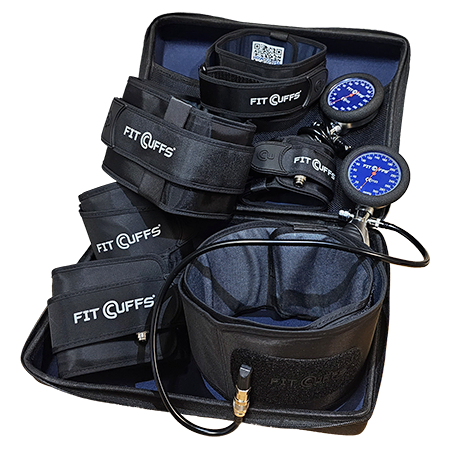
Original price was: 455 €.362 €Current price is: 362 €.Includes
➤2 x Leg Cuffs V5.0 (45-83 cm / 17.7-32.7 Inch) Black/Dark Blue And/Or 2 x Leg Cuffs V4.0 (45-80 cm / 17.7-31.5 Inch) Black/Dark Blue And/Or Leg Cuffs V3.1 (45-85 cm / 17.7-33.5 Inch) Black/Dark Blue
➤ 2 x Arm Cuffs V4.0 (20-50 cm / 7.9-20 Inch) Black/Dark Blue And/Or Arm Cuffs V3.1 (20-50 cm / 7.9-20 Inch) Black/Dark Blue
➤ Wireless Or Standard Pressure Gauge
➤ 2 pcs. Deflation Plugs + Measurement Tape
➤ Large Hard Carrying Case – dimensions tailored to accommodate contents -
Fit Cuffs | Complete x 2
Original price was: 704 €.570 €Current price is: 570 €.Includes
➤ 2 x Leg Cuffs V4.0 (45-80 cm / 17.7-31.5 Inch) Black/Dark Blue
And/Or
➤ 2 x Leg Cuffs V3.1 (45-85 cm / 17.7-33.5 Inch) Black/Dark Blue
And/Or
➤ 2 x Leg Cuffs V5.0 (45-82 cm / 17.7-32 Inch) Black/Dark Blue
➤ 2 x Arm Cuffs V4.0 (20-50 cm / 7.9-20 Inch) Black/Dark Blue
And/Or
➤ 2 x Arm Cuffs V3.1 (20-50 cm / 7.9-20 Inch) Black/Dark Blue
➤ 2 x Wireless or Standard Pressure Gauge
➤ 2 pcs. Deflation Plugs + Measurement Tape
➤ Large Hard Carrying Case – dimensions tailored to accommodate contents